What Spring Really Celebrates: A Global Tapestry of Rituals and Renewal

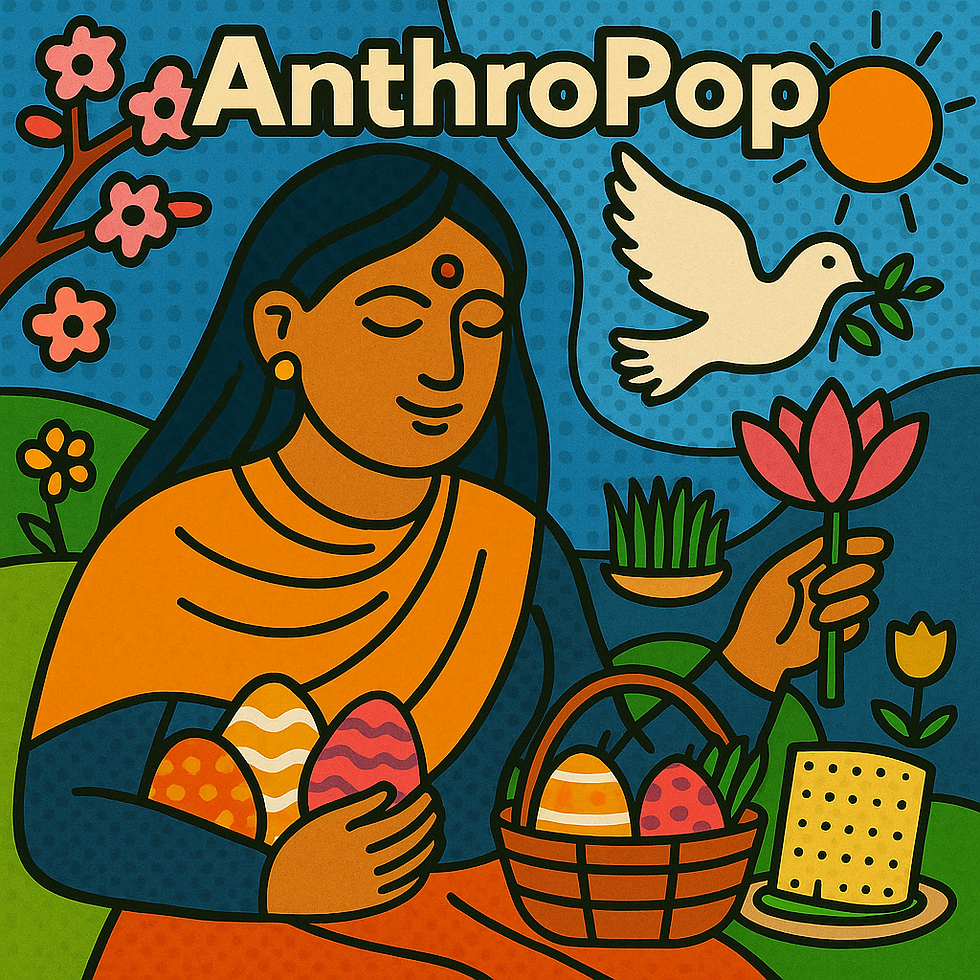
In the U.S., Easter always seems to mark the arrival of spring—whether we are culturally Christian, devoutly evangelical, Muslim, Hindu, atheist, or just spiritually unsure. The pastel décor pops up in every grocery store, and kids everywhere learn to associate this season with candy, baskets, and new clothes.
But as my mind wanders through all this cultural clutter, I can’t help but feel hopeful. There is something about spring itself—about the thaw, the bloom, the lengthening light—that reminds us: renewal is not only possible, it is cyclical. The earth begins again, and so can we. And in that spirit, I start thinking about all the rituals humans have created across time and space to honor this turning point—from fire festivals to floral offerings, from fasting to feasting.
These aren’t just charming customs. They are powerful reflections of something we do extraordinarily well: we mark change with meaning. We create rituals to process transformation, to reconnect with each other, and to remind ourselves that hope is not foolish—it’s foundational.
The human instinct to mark springtime with ritual is practically hardwired. When the earth begins to soften and the days stretch longer, we respond—not just biologically, but socially and spiritually. We gather, we plant, we celebrate fertility (of the soil, the spirit, or sometimes the literal kind), and we build meaning around the transition from scarcity to abundance. In short, we do what humans do best: we ritualize change.
Nowruz, the Persian New Year, is celebrated on the vernal equinox with roots stretching back over 3,000 years. Entire households are scrubbed clean, tables are set with symbolic items (like hyacinths, painted eggs, and sprouted wheat), and the community collectively steps into a new cycle.
Meanwhile, halfway across the globe, Holi, the Hindu Festival of Colors, erupts in a joyful mess of powdered pigments and playful chaos to welcome spring and defeat the lingering darkness of winter.
Passover tells the story of liberation from bondage, while Easter, in both its pagan and Christian lineages, marks resurrection and rebirth.
In China, the Qingming Festival is less about candy and more about connection to ancestors. Families sweep tombs, offer food, and honor those who came before—another kind of renewal, this time of memory and lineage.
And in Japan, hanami (cherry blossom viewing) invites people to pause and contemplate the beauty of fleeting moments—a different but no less powerful ritual of spring. What ties these seemingly disparate traditions together isn’t just the season—it’s the idea that change demands acknowledgment. Transformation isn’t passive. It requires action, observance, and often, a bit of pageantry.
Rituals, whether religious or secular, allow us to make sense of the liminal: those in-between spaces when we’re no longer who we were, and not yet who we’ll become. But spring isn’t always gentle. For all its flowers and fanfare, the season of new life often comes after great difficulty—cold, hunger, isolation.
Historically, spring was not a metaphor; it was a literal reprieve. The thaw meant survival. Food could grow. People could gather. The world was open again. And yet, we must also acknowledge that change doesn’t always come easily. Across the globe, the struggle to be seen, to be heard, and to have one’s traditions honored continues.
Spring might promise hope, but it often begins in tension—between what is and what could be. Strife, in its many forms, can be met with argument, resistance, even violence when voices go unheard or unseen. Sometimes, it feels like that’s the only way to get the attention of those in power.
As uncomfortable as this truth is, it’s a reminder that transformation—whether seasonal or societal—is rarely quiet. Humans, time and again, have found ways to turn rupture into ritual. We don’t just endure change—we celebrate it. And perhaps most importantly, we do it together. If there is one thing that defines our species, it is not dominance or technological prowess—it is our adaptability.
We shape-shift across geography, climate, language, and belief. But adaptability alone doesn’t ensure survival; cooperation does. From communal farming to shared altars, from rebuilding after natural disasters to holding collective vigils for justice, we move forward not in isolation but in community.
Spring, in all its muddy glory, reminds us that rebirth doesn’t happen in a vacuum. It is planted, watered, and nurtured by many hands. And in that, there is an immense, almost sacred, beauty.
So yes, the pastel eggs may be packed away or eaten. The garlands might be wilted by now. But the impulse behind them—the yearning for renewal, for connection, for meaning—is evergreen.
And maybe that’s exactly what we need right now.
In a season marked by tension, headlines, and ideological noise, spring offers a quieter counter-narrative. Not one of avoidance, but of re-centering. A reminder that transformation is possible—not because the world is easy, but because we are resilient.
We’ve always ritualized change. But now, we must ritualize care. We must practice cooperation like it’s sacred. We must mark not just the season—but our shared belonging to it.
Because no matter our beliefs, traditions, or doubts, one truth remains: We begin again. Together.
Stay curious and hopeful,
AP


Comments